
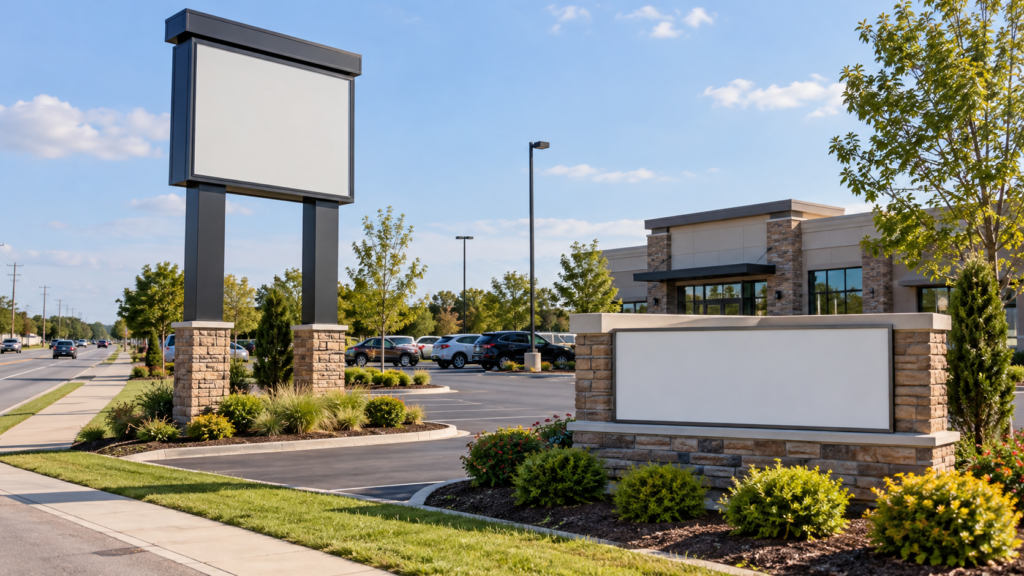
Choose a pylon sign if your business depends on drivers spotting you from a highway or a busy road at speed. Choose a monument sign if your property sits close to the street, your customers arrive at lower speeds, or local zoning limits sign height. Pylon signs win on reach. Monument signs win on curb appeal and fit.
Both are freestanding signs that stand on their own foundation, separate from your building. The right one depends on your location, traffic speed, zoning rules, and budget. This guide breaks down how each sign works, where each one performs best, and what to plan for before you invest.
What Is a Pylon Sign?
A pylon sign is a tall freestanding sign mounted on one or more poles or a structural column, with the sign cabinet raised high above the ground. Many businesses call them pole signs or highway signs. Heights commonly range from around 15 feet to well over 40 feet, depending on the site and what local code allows.
Pylon signs put your brand above traffic, parked cars, and neighboring buildings. That height gives drivers time to see your sign, read it, and change lanes before they reach your entrance.
You see pylon signs most often at these types of businesses.
- Gas stations and convenience stores
- Fast food and quick service restaurants
- Hotels and travel centers along highways
- Shopping centers that list multiple tenants on one structure
- Auto dealerships and large retail stores
Most pylon signs use illuminated cabinet faces, channel letters, or an LED message center so they stay visible at night. Multi-tenant pylons stack several tenant panels on one structure, which makes them a common choice for retail centers.
Because of their height and wind load, pylon signs need engineered steel supports and deep concrete foundations. Installation typically involves drilling for the footing and crane work to set the structure. Learn more about our custom pylon signs.
What Is a Monument Sign?
A custom monument sign is a low-profile freestanding sign built on a solid base that sits directly on the ground. Most monument signs stand around 4 to 8 feet tall and sit near the property entrance or along the street frontage.
Monument signs read at eye level for drivers and pedestrians, which makes them ideal for properties where customers approach at lower speeds. Builders often finish the base in brick, stone, stucco, or aluminum to match the building, so the sign looks like part of the property.
You see monument signs most often at these types of properties.
- Office buildings and corporate campuses
- Medical and dental offices
- Churches and schools
- Banks and financial institutions
- Apartment communities and neighborhoods
- Business parks and multi-tenant office centers
Monument signs can include dimensional letters, illuminated cabinets, halo-lit letters, or an LED message center built into the base. Their lower height means they often face fewer zoning restrictions, and landscaping around the base adds even more curb appeal. See our custom monument signs for design options.
Pylon Sign vs. Monument Sign at a Glance
The biggest differences come down to height, viewing distance, and how much structure each sign needs.
| Factor | Pylon Sign | Monument Sign |
|---|---|---|
| Typical height | Around 15 to 40+ feet | Around 4 to 8 feet |
| Viewing distance | Long range, built for highway speeds | Short to medium range, built for eye level |
| Best traffic type | Highways, interstates, fast arterial roads | Local streets, entrances, walkable areas |
| Structure | Steel poles or columns on a deep concrete footing | Solid base on a shallow slab or footing |
| Look and feel | Bold, high-visibility, commercial | Polished, upscale, blends with the property |
| Zoning and permits | Stricter height, setback, and engineering review | Fewer restrictions in most districts |
| Installation | Drilling plus crane work in most cases | Lighter equipment, faster install |
| Relative cost | Higher, driven by height, steel, and foundation | Lower for most sizes, higher with masonry finishes |
| Multi-tenant use | Common in shopping centers | Common in office parks and medical plazas |
When a Pylon Sign Makes Sense
A pylon sign pays off when visibility from a distance drives your revenue. If customers decide to stop within a few seconds of seeing you, height gives you the edge.
Pick a pylon sign if these describe your site.
- Your business sits along a highway or high-speed road. Drivers moving 55 to 75 mph need to see your sign well before your exit or entrance.
- Buildings, trees, or parked cars block the view. A tall pylon clears obstructions that hide a ground-level sign.
- Your property sits back from the road. When your building sits deep in a lot, the pylon carries your brand out to the traffic.
- You rely on impulse stops. Fuel, food, lodging, and auto service customers often choose the first brand they spot.
- You manage a multi-tenant center. One pylon can advertise every tenant to passing traffic.
Pair a pylon with an LED message center to promote pricing, specials, or events that change daily. Plan for the drilling and crane work a tall structure requires, and confirm height limits with your city before you finalize the design.
When a Monument Sign Makes Sense
A monument sign pays off when first impressions and brand image matter as much as raw visibility. It tells customers they found the right place and sets the tone before they walk in.
Pick a monument sign if these describe your site.
- Customers approach at lower speeds. Local streets, parking lot entrances, and drive aisles give people time to read at eye level.
- Your property sits close to the road. A monument sign near the entrance reads clearly without extra height.
- Your brand leans professional or upscale. Law firms, medical practices, banks, and corporate offices benefit from a polished, permanent look.
- Local code limits sign height. Many suburban districts and master-planned communities cap freestanding signs at lower heights or require ground-mounted designs.
- You want the sign to match your architecture. A masonry or stucco base ties the sign to your building materials and landscaping.
Monument signs also work well for wayfinding. Place one at each entrance of a campus or business park to guide visitors to the right building.
Permits, Zoning, and Cost Factors in Texas
In Texas, your city sets the rules for freestanding signs, so check local code before you pick a style. Height limits, square footage caps, setbacks from the property line, and lighting rules all vary by city and zoning district. Houston has no traditional zoning, yet it still enforces its own sign code. Suburbs and master-planned communities often add stricter design standards on top of city rules.
Pylon signs usually face more review because of their height. Expect engineered drawings, wind load calculations, and foundation details with your permit application. Monument signs often move through permitting faster, though some communities require specific base materials or landscaping.
Several factors shape the final price of either sign.
- Size and height. Taller structures need more steel, deeper footings, and heavier equipment.
- Illumination. LED-lit cabinets, halo-lit letters, and digital message centers add cost and long-term value. Our business sign cost guide breaks down price ranges by sign type.
- Materials and finishes. Brick, stone, and custom fabrication raise the price of a monument base.
- Foundation and installation. Drilling, concrete, and crane time make up a larger share of pylon sign budgets.
- Permits and engineering. Fees and stamped drawings vary by city.
- Electrical work. Running power to the sign location adds to site prep.
A full-service sign company handles design, engineering, fabrication, and installation under one roof, which keeps your project on schedule and inside code. Extreme Signs manages each step with in-house drilling and crane and rigging crews.
Frequently Asked Questions
What is the difference between a pylon sign and a monument sign?
A pylon sign stands tall on poles or a column to reach drivers from a distance. A monument sign sits low on a solid base at ground level for eye-level visibility near the entrance.
Is a pylon sign the same as a pole sign?
Most people use the terms interchangeably. Some sign makers use “pole sign” for a cabinet on exposed poles and “pylon sign” for a design that wraps the poles in a decorative cover.
How tall is a monument sign?
Most monument signs stand between 4 and 8 feet tall. Local code sets the maximum height for your property.
Which sign costs more, a pylon or a monument sign?
Pylon signs usually cost more because of their height, steel structure, deep foundation, and crane installation. A large monument sign with a masonry base and LED display can still reach a similar budget.
Do I need a permit for a pylon or monument sign in Texas?
Most Texas cities require a permit for any permanent freestanding sign. Pylon signs typically need engineered drawings, and both types must meet local height, size, and setback rules.
Can I add an LED message center to either sign?
Yes. Both pylon and monument signs can include a built-in LED message center, as long as local code allows digital displays at your location.
Find the Right Freestanding Sign for Your Business
The best sign matches your traffic, your property, and your brand. Highway-facing businesses usually get the most return from a pylon sign. Businesses that greet customers at the entrance usually get more from a monument sign. Some properties use both, with a pylon for the road and a monument at the driveway.
Extreme Signs designs, builds, and installs custom pylon and monument signs for businesses across Texas. Our team reviews your site, checks local sign code, and recommends the style that fits your goals. Request a quote to start your project.